Building Trust From Zero
Hubz • 2025 • Product Designer
Web3 Community
Token-Gating
Telegram Mini App
Crypto
Role: Product DesignerScope: UX, UI, visual design, interaction design, prototypingOutcome: 0 → 5,000+ connected wallets
Hubz began as a lightweight Telegram Mini App and evolved into a Web3 onboarding engine—helping projects like Moonbirds and Bored Ape Yacht Club launch exclusive, token-gated communities.Through rapid UX iteration and focused visual refinement, we transformed a confusing crypto flow into a fast, trustworthy experience that scaled from near-zero usage to 5,000+ connected wallets.
Understanding Web3 Communities
We interviewed community admins and members, then validated concepts through early prototypes. These insights guided a single design principle:Make every step feel intentional & explainable.
- Security = trust. Admins valued token-gating as a way to protect community quality and reduce spam.
- TON ecosystem unfamiliarity. Many users were unfamiliar with TON and its wallets. This unfamiliarity amplified distrust when bots requested wallet access—especially without clear context or explanation.
- Curiosity without clarity. Members were interested in tokens and perks, but needed a clear, low-friction entry point.
Design Strategy
Rather than building a broad feature set, we focused on three core experiences centered around token-gating—making deliberate trade-offs to reduce complexity and friction.
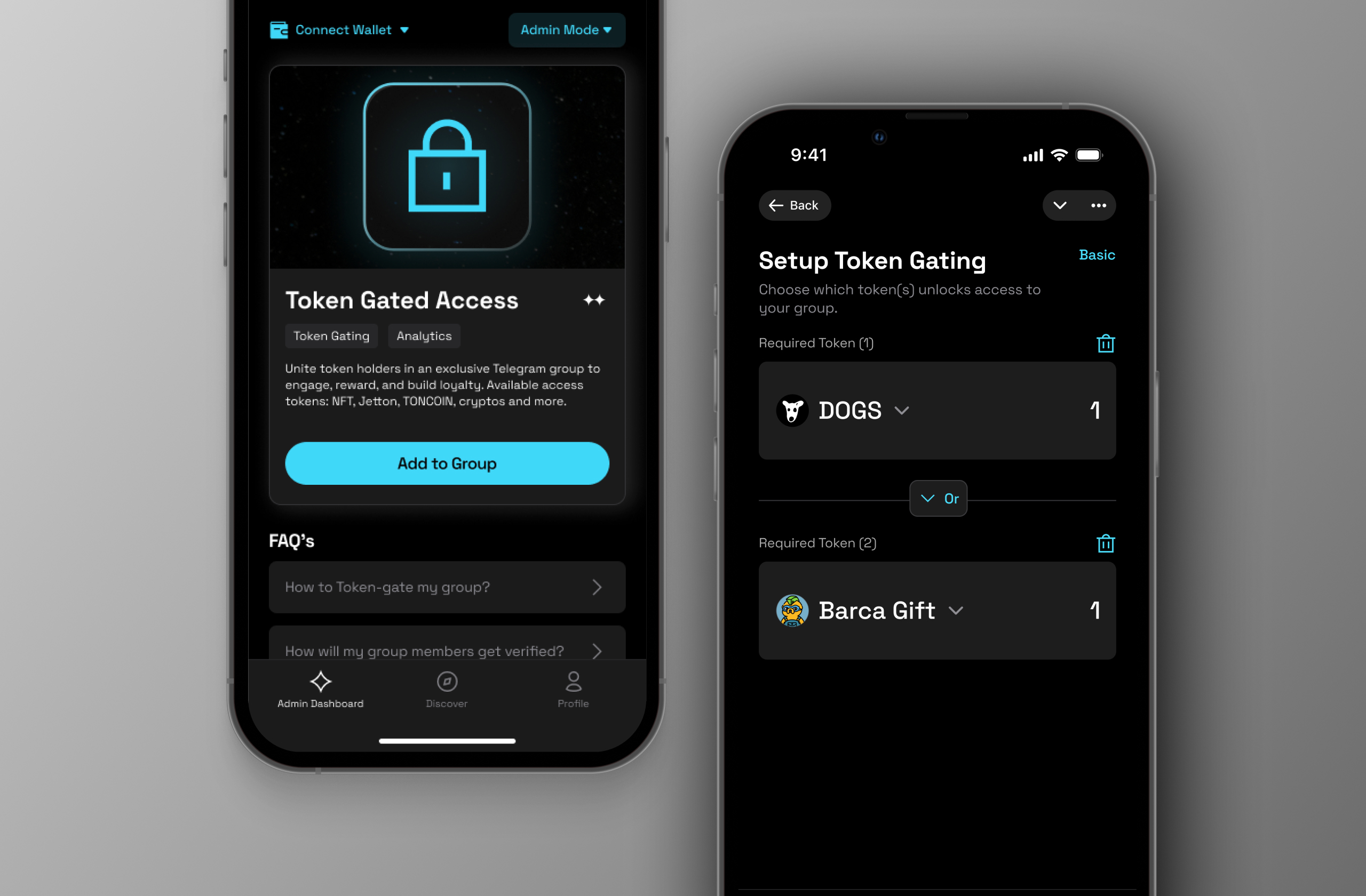
Token-Gating Setup (Admin Experience)
Admins needed flexibility without feeling overwhelmed. Design decisions: Progressive disclosure instead of dense configuration screens. Attention to interaction details: Contract address open text field, Easy-to-scan multi-token settings, Visual hierarchies to separate “required” vs “advanced” options.
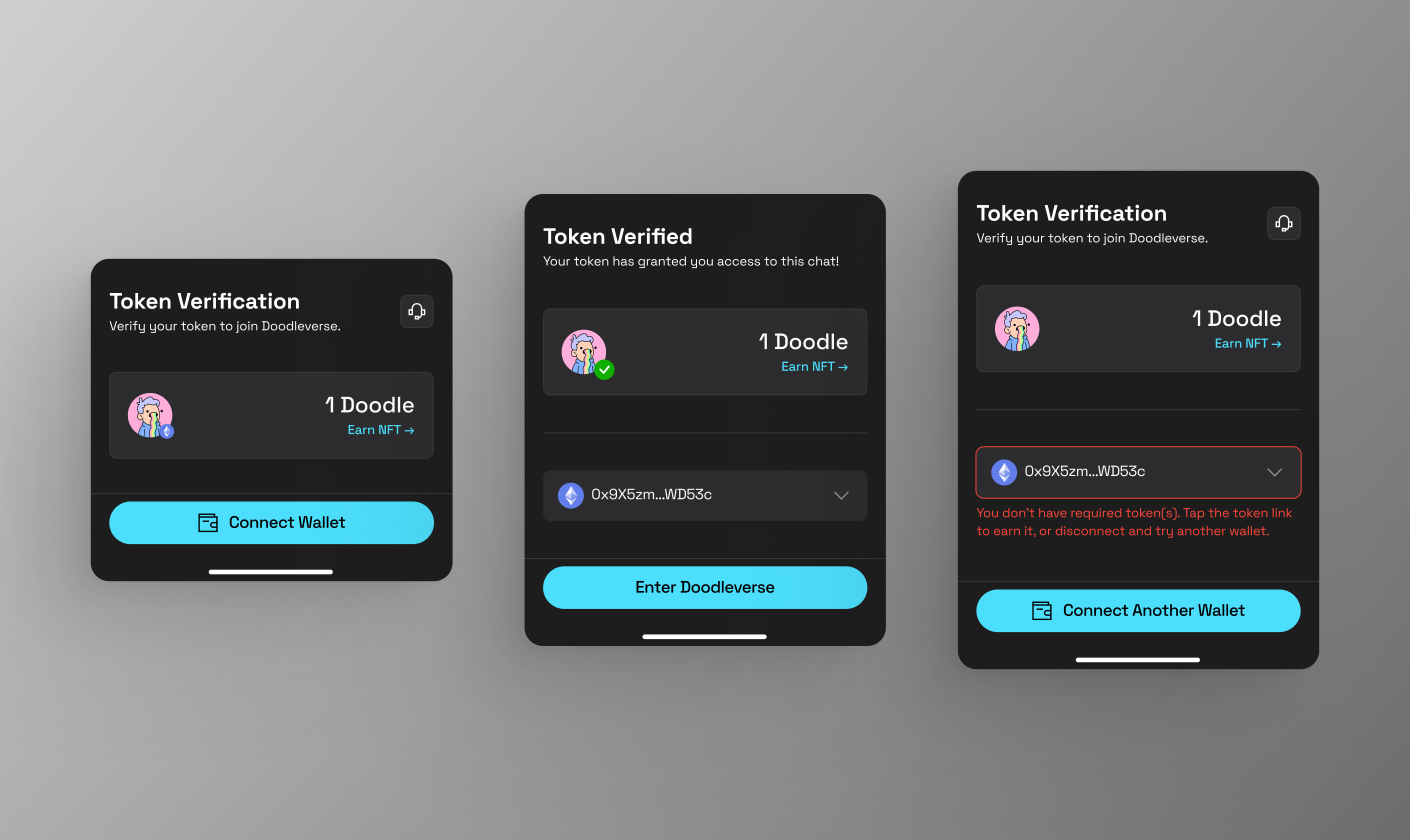
Verify Token To Join (Member Experience)
This was the most trust-sensitive moment. Design focus:Familiar wallet connection patterns. Clear visual feedback for success, failure, and retry states. The goal was to make verification feel more like logging in than making a transaction.
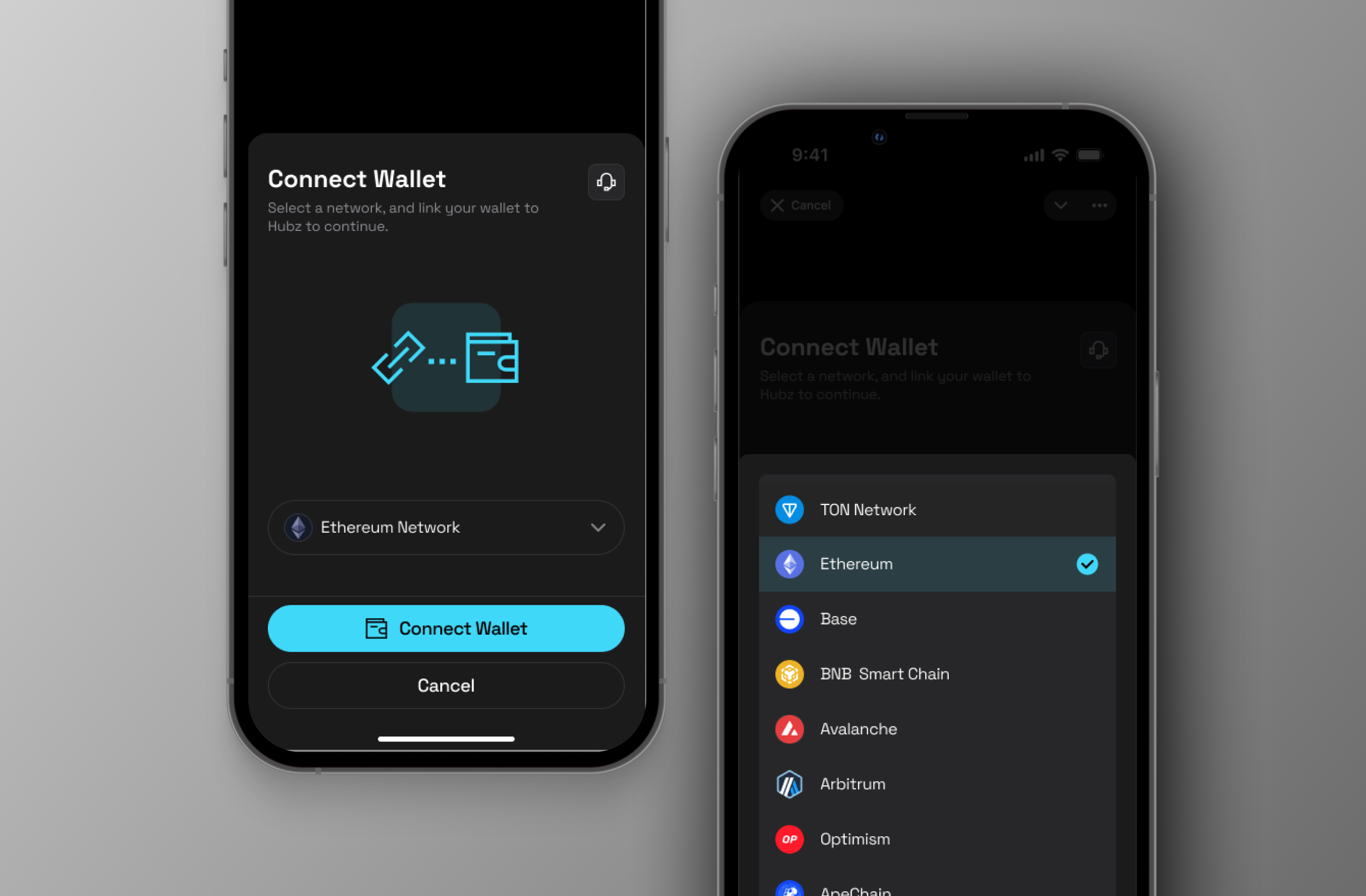
Multi-Chain Support
Originally TON-only, Hubz expanded to support multiple chains based on direct user demand.From a design standpoint, multi-chain support became a credibility signal—showing users that Hubz was built for authentic web3 communities.
Takeaways
Alongside core flows, we explored additional engagement features: Token-gated drops, Community discovery, Admin analytics, DAO-style governance concepts. These were tested through lightweight prototypes to validate interest before deeper investment.This project pushed me to design in an environment with high uncertainty and low user trust. If I were to revisit it, I would approach a few things differently: Ecosystem > Products: We can’t solve the problem if the real issue is the ecosystem - intentionally choose where to build on. Design a Clear Visual Trust System Earlier: We relied mainly on copy and familiar patterns to build trust. With more time, I’d introduce a more explicit visual trust system—such as verification states, security indicators, or branded reassurance moments—to reduce anxiety even further.
Works →
Building Trust From Zero
Hubz • 2025 • Product Designer
Web3 Community
Token-Gating
Telegram Mini App
Crypto
Role: Product DesignerScope: UX, UI, visual design, interaction design, prototypingOutcome: 0 → 5,000+ connected wallets
Hubz began as a lightweight Telegram Mini App and evolved into a Web3 onboarding engine—helping projects like Moonbirds and Bored Ape Yacht Club launch exclusive, token-gated communities.Through rapid UX iteration and focused visual refinement, we transformed a confusing crypto flow into a fast, trustworthy experience that scaled from near-zero usage to 5,000+ connected wallets.
Understanding Web3 Communities
We interviewed community admins and members, then validated concepts through early prototypes. These insights guided a single design principle:Make every step feel intentional & explainable.
- Security = trust. Admins valued token-gating as a way to protect community quality and reduce spam.
- TON ecosystem unfamiliarity. Many users were unfamiliar with TON and its wallets. This unfamiliarity amplified distrust when bots requested wallet access—especially without clear context or explanation.
- Curiosity without clarity. Members were interested in tokens and perks, but needed a clear, low-friction entry point.
Design Strategy
Rather than building a broad feature set, we focused on three core experiences centered around token-gating—making deliberate trade-offs to reduce complexity and friction.
Token-Gating Setup (Admin Experience)
Admins needed flexibility without feeling overwhelmed. Design decisions: Progressive disclosure instead of dense configuration screens. Attention to interaction details: Contract address open text field, Easy-to-scan multi-token settings, Visual hierarchies to separate “required” vs “advanced” options.
Verify Token To Join (Member Experience)
This was the most trust-sensitive moment. Design focus:Familiar wallet connection patterns. Clear visual feedback for success, failure, and retry states. The goal was to make verification feel more like logging in than making a transaction.
Multi-Chain Support
Originally TON-only, Hubz expanded to support multiple chains based on direct user demand.From a design standpoint, multi-chain support became a credibility signal—showing users that Hubz was built for authentic web3 communities.
Takeaways
Alongside core flows, we explored additional engagement features: Token-gated drops, Community discovery, Admin analytics, DAO-style governance concepts. These were tested through lightweight prototypes to validate interest before deeper investment.This project pushed me to design in an environment with high uncertainty and low user trust. If I were to revisit it, I would approach a few things differently: Ecosystem > Products: We can’t solve the problem if the real issue is the ecosystem - intentionally choose where to build on. Design a Clear Visual Trust System Earlier: We relied mainly on copy and familiar patterns to build trust. With more time, I’d introduce a more explicit visual trust system—such as verification states, security indicators, or branded reassurance moments—to reduce anxiety even further.
Works →
Building Trust From Zero
Hubz • 2025 • Product Designer
Web3 Community
Token-Gating
Telegram Mini App
Crypto
Role: Product DesignerScope: UX, UI, visual design, interaction design, prototypingOutcome: 0 → 5,000+ connected wallets
Hubz began as a lightweight Telegram Mini App and evolved into a Web3 onboarding engine—helping projects like Moonbirds and Bored Ape Yacht Club launch exclusive, token-gated communities.Through rapid UX iteration and focused visual refinement, we transformed a confusing crypto flow into a fast, trustworthy experience that scaled from near-zero usage to 5,000+ connected wallets.
Understanding Web3 Communities
We interviewed community admins and members, then validated concepts through early prototypes. These insights guided a single design principle:Make every step feel intentional & explainable.
- Security = trust. Admins valued token-gating as a way to protect community quality and reduce spam.
- TON ecosystem unfamiliarity. Many users were unfamiliar with TON and its wallets. This unfamiliarity amplified distrust when bots requested wallet access—especially without clear context or explanation.
- Curiosity without clarity. Members were interested in tokens and perks, but needed a clear, low-friction entry point.
Design Strategy
Rather than building a broad feature set, we focused on three core experiences centered around token-gating—making deliberate trade-offs to reduce complexity and friction.
Token-Gating Setup (Admin Experience)
Admins needed flexibility without feeling overwhelmed. Design decisions: Progressive disclosure instead of dense configuration screens. Attention to interaction details: Contract address open text field, Easy-to-scan multi-token settings, Visual hierarchies to separate “required” vs “advanced” options.
Verify Token To Join (Member Experience)
This was the most trust-sensitive moment. Design focus:Familiar wallet connection patterns. Clear visual feedback for success, failure, and retry states. The goal was to make verification feel more like logging in than making a transaction.
Multi-Chain Support
Originally TON-only, Hubz expanded to support multiple chains based on direct user demand.From a design standpoint, multi-chain support became a credibility signal—showing users that Hubz was built for authentic web3 communities.
Takeaways
Alongside core flows, we explored additional engagement features: Token-gated drops, Community discovery, Admin analytics, DAO-style governance concepts. These were tested through lightweight prototypes to validate interest before deeper investment.This project pushed me to design in an environment with high uncertainty and low user trust. If I were to revisit it, I would approach a few things differently: Ecosystem > Products: We can’t solve the problem if the real issue is the ecosystem - intentionally choose where to build on. Design a Clear Visual Trust System Earlier: We relied mainly on copy and familiar patterns to build trust. With more time, I’d introduce a more explicit visual trust system—such as verification states, security indicators, or branded reassurance moments—to reduce anxiety even further.
Works →